Networking & Content Delivery
Category: AWS VPN
Streamline AWS Client VPN usage reporting with Amazon CloudWatch Logs Insights queries
AWS Client VPN is a managed client-based VPN service that enables you to securely access your Amazon Web Services (AWS) resources and resources in your on-premises network. Amazon CloudWatch Logs Insights allows you to interactively search and analyze your log data in Amazon CloudWatch Logs. You can perform queries to help you more efficiently and […]

AWS Site-to-Site VPN and eero make remote connectivity for distributed sites simpler
Amazon Web Services (AWS) is working with eero to make it simpler and more convenient for organizations to establish secure connectivity between their remote sites and AWS in just a few clicks. The integration of AWS Site-to-Site VPN with eero’s devices enables organizations to scale site connectivity across many locations faster and more efficient, without requiring […]

Scaling AWS VPN maintenance with tunnel endpoint lifecycle automation
Amazon Web Services (AWS) Site-to-Site VPN is a fully managed service that can create a secure connection between your data center or branch office and your AWS resources using IP Security (IPSec) tunnels. A Site-to-Site VPN connection consists of two VPN tunnels for redundancy. As a managed service, Site-to-Site VPN periodically applies updates to your […]
Introducing AWS Site-to-Site VPN 5 Gbps Tunnels to support high throughput workloads
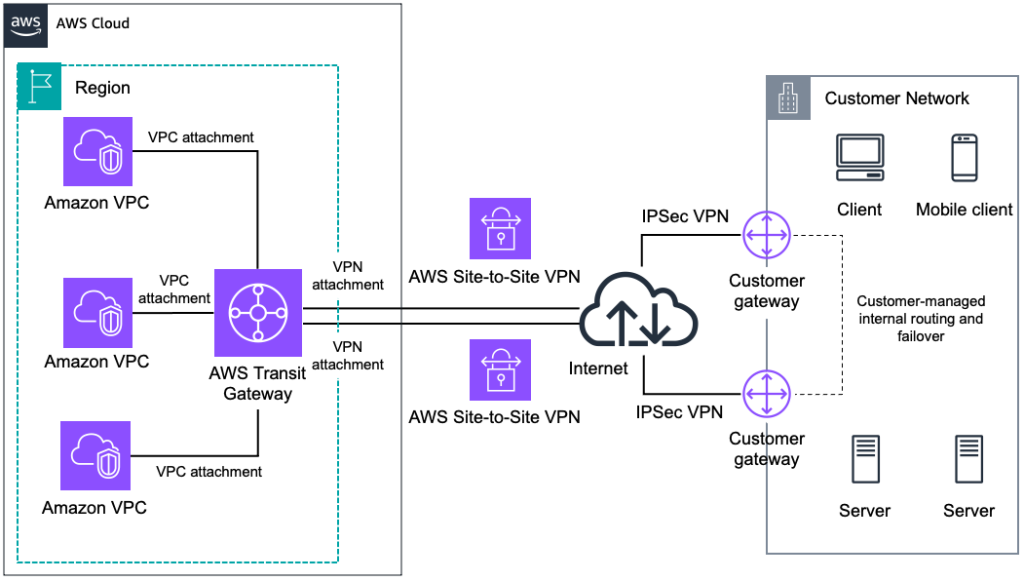
AWS Site-to-Site VPN now supports VPN connections with up to 5 Gbps bandwidth per tunnel, a 4x improvement from existing limit of 1.25 Gbps. This increased bandwidth benefits customers who require high-capacity connections for bandwidth-intensive hybrid applications, big data migrations, and disaster recovery architectures. AWS Site-to-Site VPN is a fully managed service that allows you […]
AWS Site-to-Site VPN now supports IPv6 on the outside IPs
Amazon Web Services (AWS) Site-to-Site VPN is a fully managed service that allows you to create a secure connection between your data center or branch office and your AWS resources using IP Security (IPSec) tunnels. It provides critical connectivity for a variety of workloads: connecting on-premises workloads to the cloud, connecting devices to the cloud, and […]

Best Practices to Optimize Failover Times for Overlay Tunnels on AWS Direct Connect
Introduction Optimized failover times in hybrid connectivity are critical for meeting availability Key Performance Indicators (KPIs) in modern enterprise workloads. This is particularly important when implementing overlay tunnels over Amazon Web Services (AWS) Direct Connect, such as AWS Site-to-Site VPN using IPSec tunnels, or Connect Attachments using Generic Routing Encapsulation (GRE) tunnels. Proper configuration can […]

Building secure multicloud access with AWS Client VPN and AWS Site-to-Site VPN
In today’s rapidly evolving cloud landscape, organizations are increasingly adopting multicloud strategies for several compelling reasons. Following mergers and acquisitions, companies need to integrate and maintain existing cloud solutions from both organizations. Different business units within an organization often have varying technical requirements and expertise, leading them to prefer specific cloud providers. For highly regulated […]

Encrypt DNS queries using DNS-over-HTTPS (DoH) with Amazon Route 53 Resolver Endpoints
Customers frequently use on-premises DNS infrastructure to resolve DNS queries for internal domains. In 2018, we announced Amazon Route 53 Resolver endpoints, which enable customers to integrate Route 53 with their on-premises DNS infrastructure for hybrid DNS resolution. In 2023, we improved this integration by providing customers the ability to encrypt DNS queries and responses […]

Setting up of AWS Site-to-Site VPN automated monitoring solution
In today’s interconnected world, businesses of all sizes rely on secure and efficient network connectivity to operate seamlessly across multiple locations. Amazon Web Services (AWS) Site-to-Site Virtual Private Networks (Site-to-Site VPN) offer a reliable way to extend a private network across public infrastructure such as the internet, enabling organizations to securely connect their offices, data centers, and Amazon Virtual […]

Networking best practices for generative AI on AWS
Introduction As generative artificial intelligence (generative AI) continues to evolve, the demand for more powerful and efficient computing resources grows, along with the need to manage exponentially increasing amounts of data. Datasets used for training generative AI models are typically measured in terabytes (TB), orders of magnitude bigger than traditional machine learning (ML) datasets whose […]