AWS Architecture Blog
Category: Application Integration
How Mapfre Insurance modernized fraud claims with Amazon EMR Serverless
Insurance fraud remains a significant challenge for the insurance industry because fraudulent claims can increase loss costs, reduce trust, and consume investigation capacity that could otherwise be focused on serving customers. Traditional fraud detection approaches typically rely on rules-based controls, manual investigation triggers, historical claim patterns, and structured-data-only analysis. These approaches are useful for known […]
Building highly available Oracle databases with Amazon FSx for NetApp ONTAP
This post shows how to build a highly available Oracle database architecture using FSxN shared storage, Auto Scaling groups with dynamic AMI updates, and serverless orchestration to help reduce recovery times with current configurations.
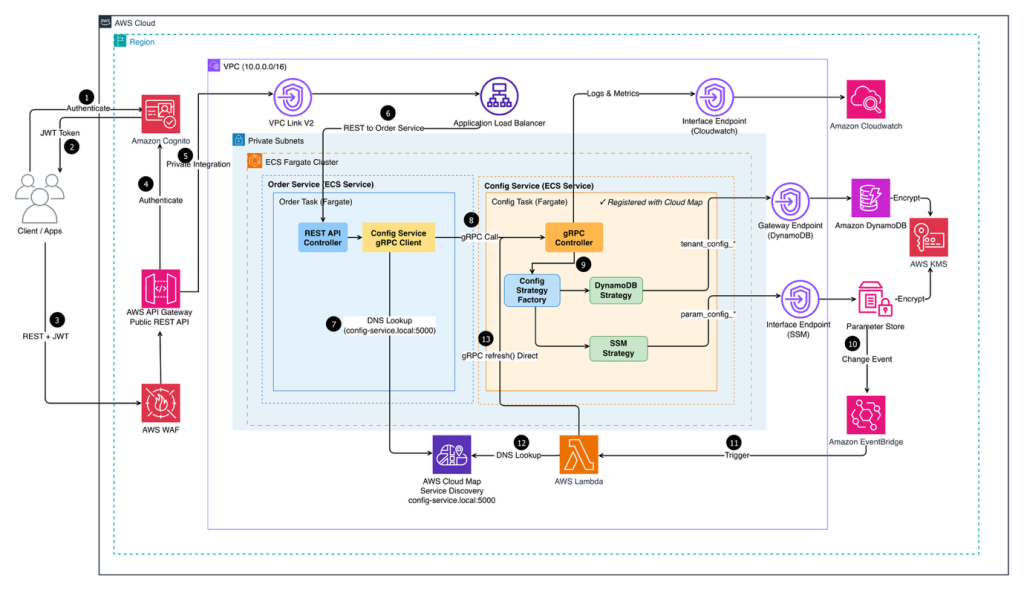
Build a multi-tenant configuration system with tagged storage patterns
In this post, we demonstrate how you can build a scalable, multi-tenant configuration service using the tagged storage pattern, an architectural approach that uses key prefixes (like tenant_config_ or param_config_) to automatically route configuration requests to the most appropriate AWS storage service. This pattern maintains strict tenant isolation and supports real-time, zero-downtime configuration updates through event-driven architecture, alleviating the cache staleness problem.
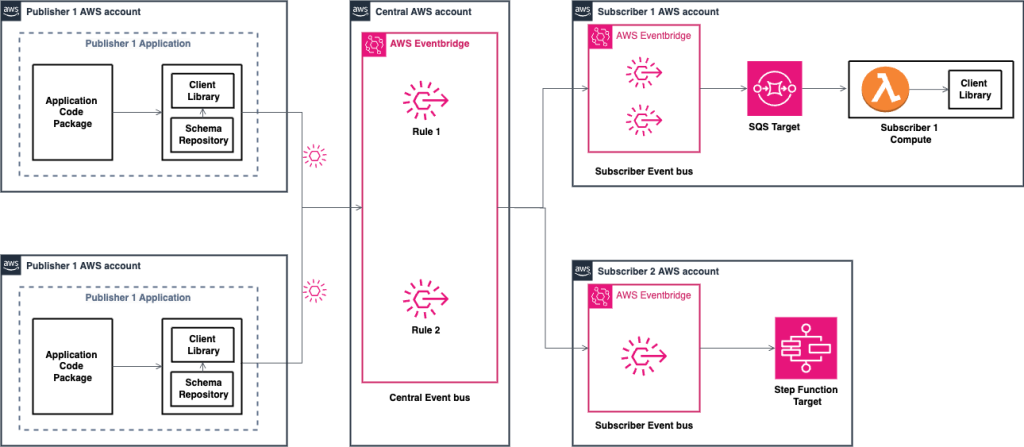
Mastering millisecond latency and millions of events: The event-driven architecture behind the Amazon Key Suite
In this post, we explore how the Amazon Key team used Amazon EventBridge to modernize their architecture, transforming a tightly coupled monolithic system into a resilient, event-driven solution. We explore the technical challenges we faced, our implementation approach, and the architectural patterns that helped us achieve improved reliability and scalability. The post covers our solutions for managing event schemas at scale, handling multiple service integrations efficiently, and building an extensible architecture that accommodates future growth.

How UNiDAYS achieved AWS Region expansion in 3 weeks
In this post, we share how UNiDAYS achieved AWS Region expansion in just 3 weeks using AWS services.

WellRight modernizes to an event-driven architecture to manage bursty and unpredictable traffic
In this post, we share how WellRight optimized the cost and performance of their application through a ground-up modernization to an event-driven architecture.

Create a serverless custom retry mechanism for stateless queue consumers
In this post, we propose a solution that handles serverless retries when the workflow’s state isn’t managed by an additional service.

How CyberArk is streamlining serverless governance by codifying architectural blueprints
This post was co-written with Ran Isenberg, Principal Software Architect at CyberArk and an AWS Serverless Hero. Serverless architectures enable agility and simplified cloud resource management. Organizations embracing serverless architectures build robust, distributed cloud applications. As organizations grow and the number of development teams increases, maintaining architectural consistency, standardization, and governance across projects becomes crucial. […]

Top Architecture Blog Posts of 2023
2023 was a rollercoaster year in tech, and we at the AWS Architecture Blog feel so fortunate to have shared in the excitement. As we move into 2024 and all of the new technologies we could see, we want to take a moment to highlight the brightest stars from 2023. As always, thanks to our […]

Use a reusable ETL framework in your AWS lake house architecture
Data lakes and lake house architectures have become an integral part of a data platform for any organization. However, you may face multiple challenges while developing a lake house platform and integrating with various source systems. In this blog, we will address these challenges and show how our framework can help mitigate these issues. Lake […]