AWS Compute Blog
Category: Compute

Using WebSockets and Load Balancers Part two
This post was written by Robert Zhu, Principal Developer Advocate at AWS. This article continues a blog I posted earlier about using Load Balancers on Amazon Lightsail. In this article, I demonstrate a few common challenges and solutions when combining stateful applications with load balancers. I start with a simple WebSocket application in Amazon Lightsail […]

Load testing a web application’s serverless backend
In this post, I discuss focus areas for load testing of serverless applications, and highlight two tools commonly used. I show how to configure Artillery with customized functions, and how to run tests to simulate load on the Ask Around Me application.

Using AWS ParallelCluster serverless API for AWS Batch
In this post, I show how to integrate the AWS Batch CLI by AWS ParallelCluster with API Gateway.
Best practices for handling EC2 Spot Instance interruptions
This post is contributed by Scott Horsfield – Sr. Specialist Solutions Architect, EC2 Spot Amazon EC2 Spot Instances are spare compute capacity in the AWS Cloud available to you at steep discounts compared to On-Demand Instance prices. The only difference between an On-Demand Instance and a Spot Instance is that a Spot Instance can be […]

Managing backend requests and frontend notifications in serverless web apps
Web and mobile applications usually interact with a backend service, often via an API. Many front-end applications pass requests for processing, wait for a result, and then display this to the user. This synchronous approach is only one way to handle messages, but modern applications have alternatives to provide a better user experience. There are […]

Adding voice to a CircuitPython project using Amazon Polly
An Adafruit PyPortal displaying a quote while synthesizing and playing speech using Amazon Polly. As a natural means of communication, voice is a powerful way to humanize an experience. What if you could make anything talk? This guide walks through how to leverage the cloud to add voice to an off-the-shelf microcontroller. Use it to […]

Low-latency computing with AWS Local Zones – Part 1
This post was contributed by: Pranav Chachra, Rob Chen, Alan Goodman AWS launched a Local Zone in Los Angeles (LA), California, in late 2019 at re:Invent. Since the launch, we have seen a lot of interest from you, and have worked to bring additional features and services based on your feedback. In this blog series, […]

Implementing geohashing at scale in serverless web applications
This blog post explores how you can solve geolocation queries using geohashing. I discuss how you should decide on the resolution of a geohash for your specific workload.

Building well-architected serverless applications: Approaching application lifecycle management – part 3
This series of blog posts uses the AWS Well-Architected Tool with the Serverless Lens to help customers build and operate applications using best practices. In each post, I address the nine serverless-specific questions identified by the Serverless Lens along with the recommended best practices. See the Introduction post for a table of contents and explanation […]
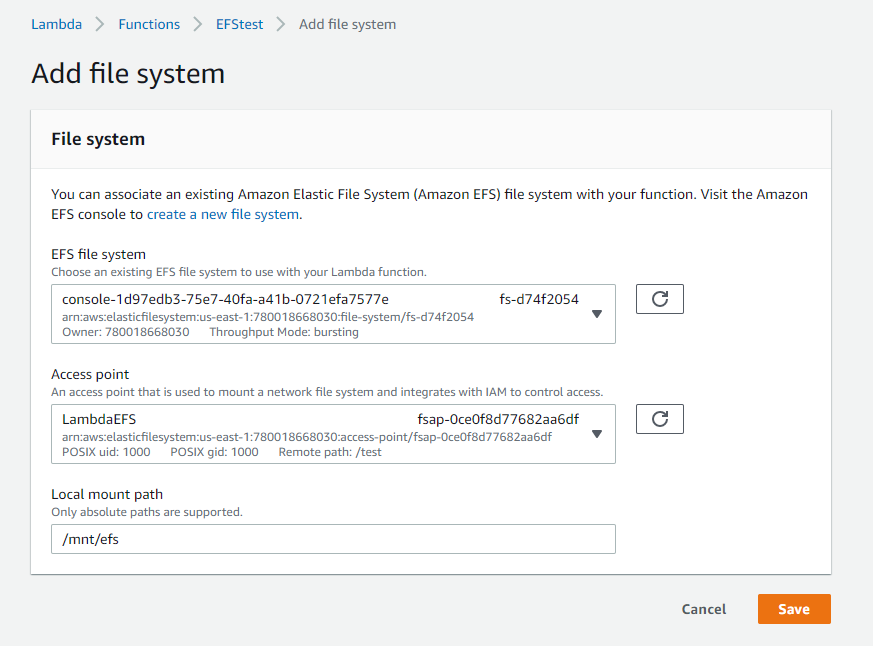
Using Amazon EFS for AWS Lambda in your serverless applications
Serverless applications are event-driven, using ephemeral compute functions to integrate services and transform data. While AWS Lambda includes a 512-MB temporary file system for your code, this is an ephemeral scratch resource not intended for durable storage. Amazon EFS is a fully managed, elastic, shared file system designed to be consumed by other AWS services, […]